Learn the solo form
Posture, rhythm and technical accuracy provide the common language.
I’m Roshan Daryanani—a Shotokan karateka, instructor and lifelong student. This is my technical notebook: a growing library of kata, kihon, kumite and practical self-defence.
Karate is where I test character, sharpen attention and learn to remain calm under pressure. Teaching turns that private discipline into service.
Shotokan is my home, but not a boundary. I train across Enfield, Walthamstow and Waltham Abbey, continuing to learn from Japanese, Okinawan and practical karate traditions.
I value precise kihon, purposeful kata, honest bunkai and kumite built on timing rather than ego. The formal goal is Yondan. The deeper aim is to keep learning—and leave every dojo stronger because I was there.
As an instructor, safeguarding and preparation matter as much as technical knowledge. I am a certified Shotokan Karate England instructor, Enhanced DBS checked, fully insured, and qualified in emergency first aid including catastrophic bleeding management.
Searchable technical notes organised by discipline. Open any article for principles, coaching cues and points for deeper study.
The five forms work as a progressive vocabulary, not five isolated performances.
The lateral movement pattern contains a close-range study of posture, off-balancing, hand-fighting and compact striking.
Kanku Dai demands contrast: expansion and compression, fast combinations and deliberate pauses.
Compare the direct modern JKA action with older angled interpretations. Know the version required in your dojo while understanding what other versions teach.
Its athletic elements must remain karate, not theatre.
Speed magnifies what is already present. Establish the line, stance, breath and endpoint before adding pace.
Okinawan vocabulary illuminates sticky heaviness, controlled hip engagement and instantaneous whole-body focus.
Use the words as training prompts, not mystical substitutes for testable mechanics.
Compare modern Shotokan with Okinawan details such as the inward thumb and higher hikite. Relate changes in shape to function.
Distance changes with stance, intention, reaction and reach.
Evasion is useful when it earns position. A small 45° movement can take the body off-line while keeping the counter direct.
The best outcome is not a successful fight; it is getting home safely. Notice early, make space, use the voice and leave.
Physical action should create an opportunity to escape.
Give one usable priority, let the student try, then recognise improvement. Demonstrate clearly, correct specifically and build independence.
From the Forces of Nature course taught with Sensei Gavin Kendal: relax, yield, rotate and return with gathering force. Roshu was studied as a connected method through kata, bunkai, jutsu and moving kumite.
Seminar study with Sensei Iain Abernethy and Sensei Les Bubka: manage weight, use both hands, control angle and position, and combine striking, throwing and gripping as circumstances require.
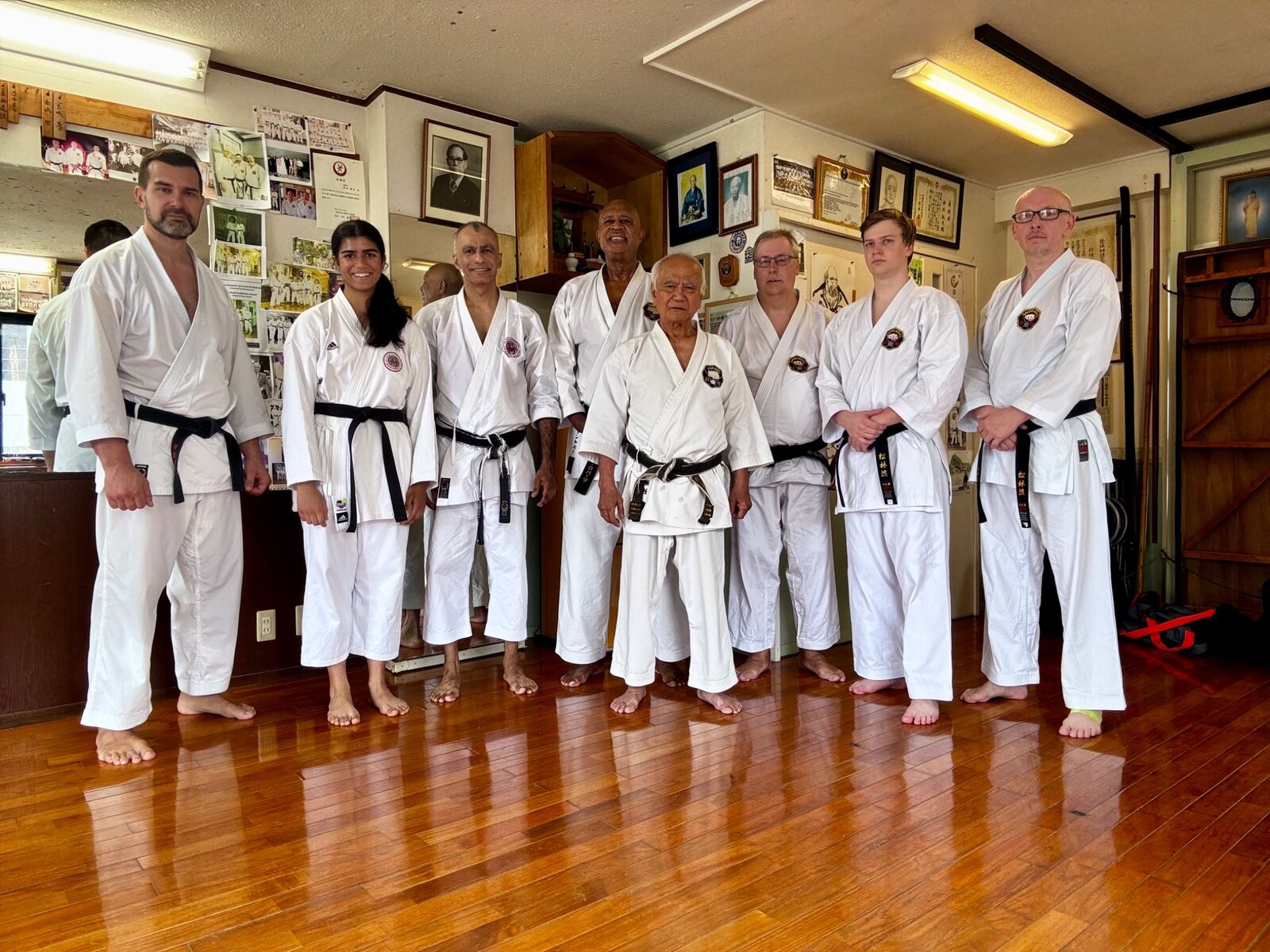
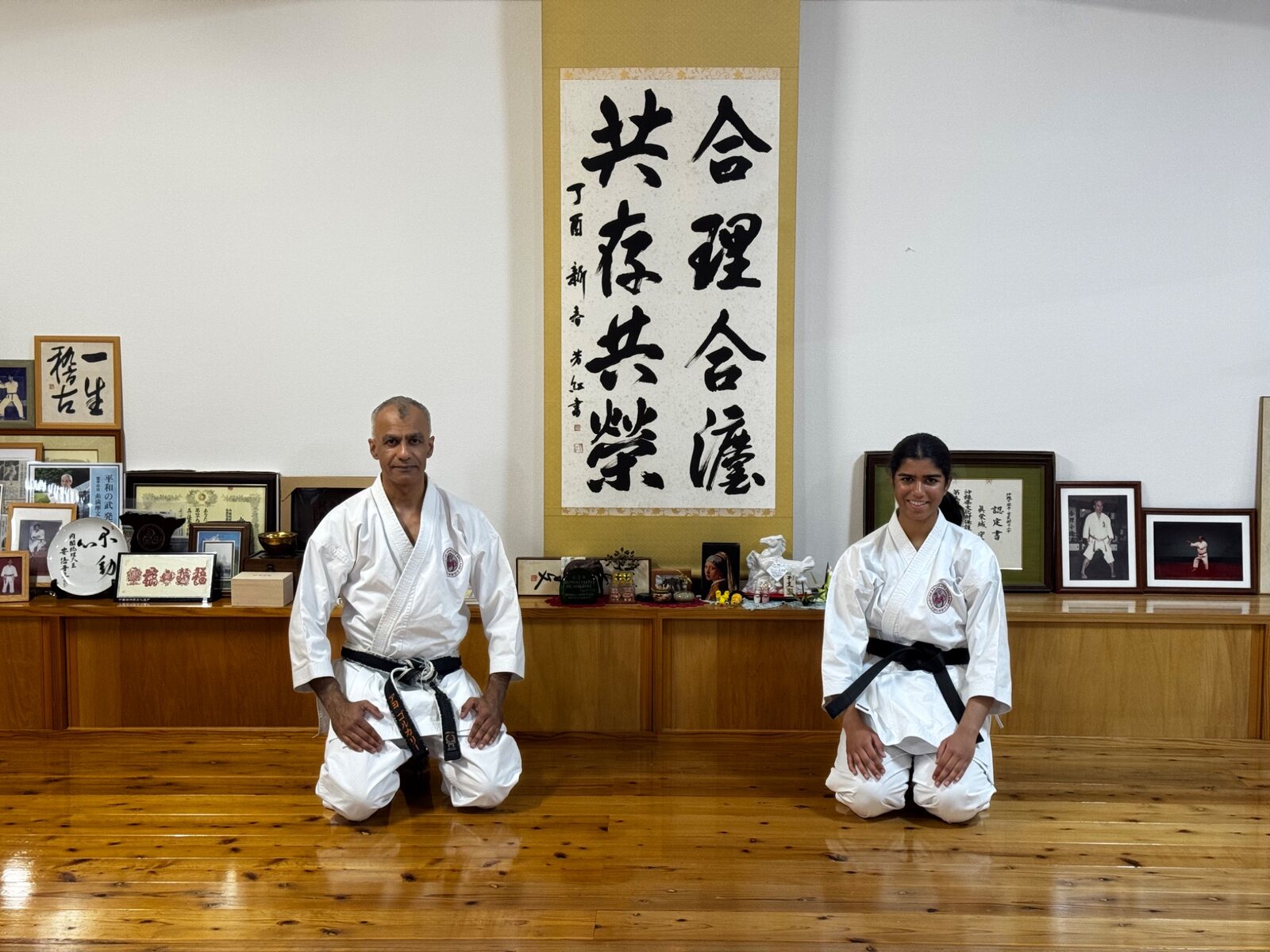
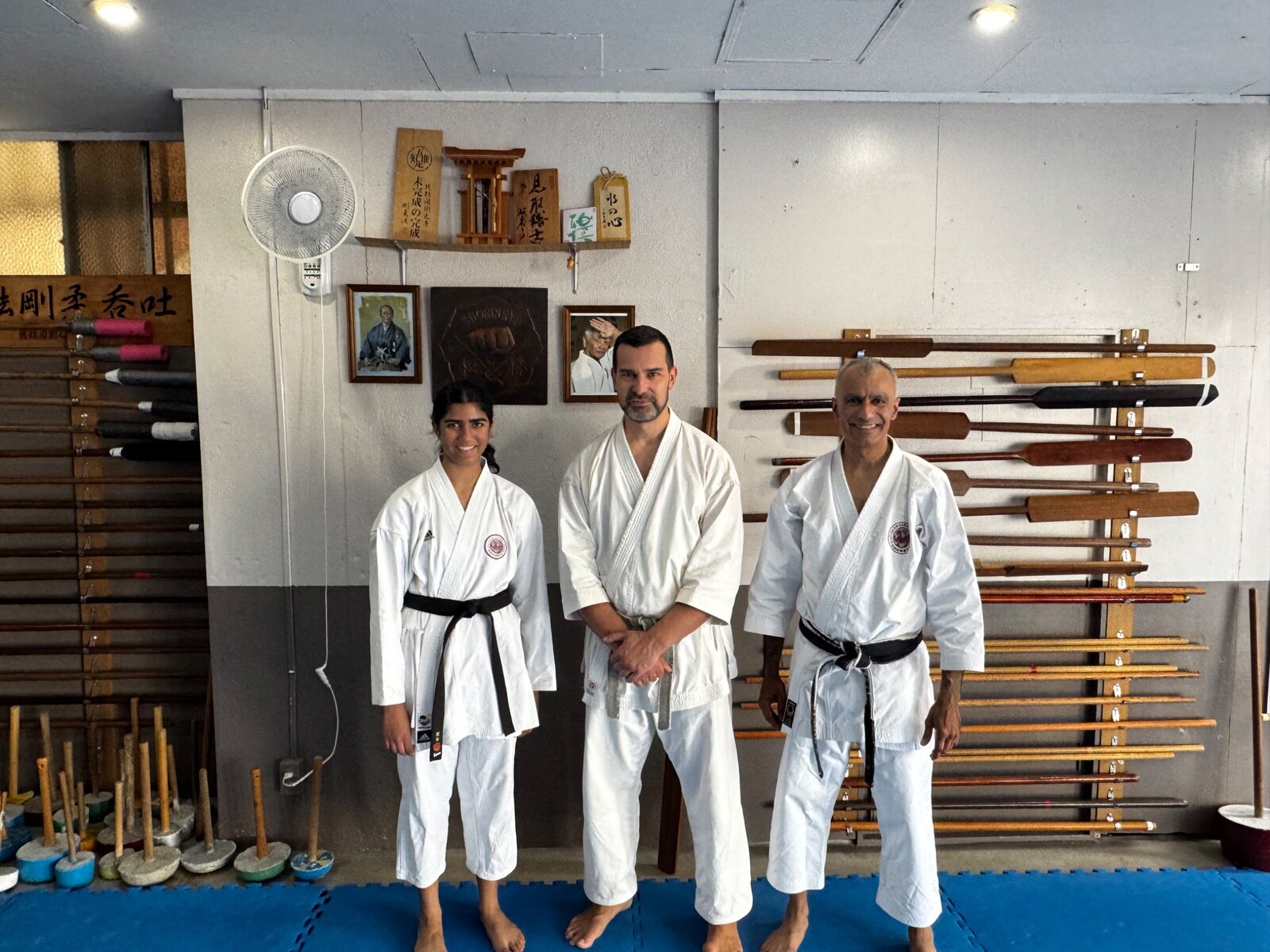
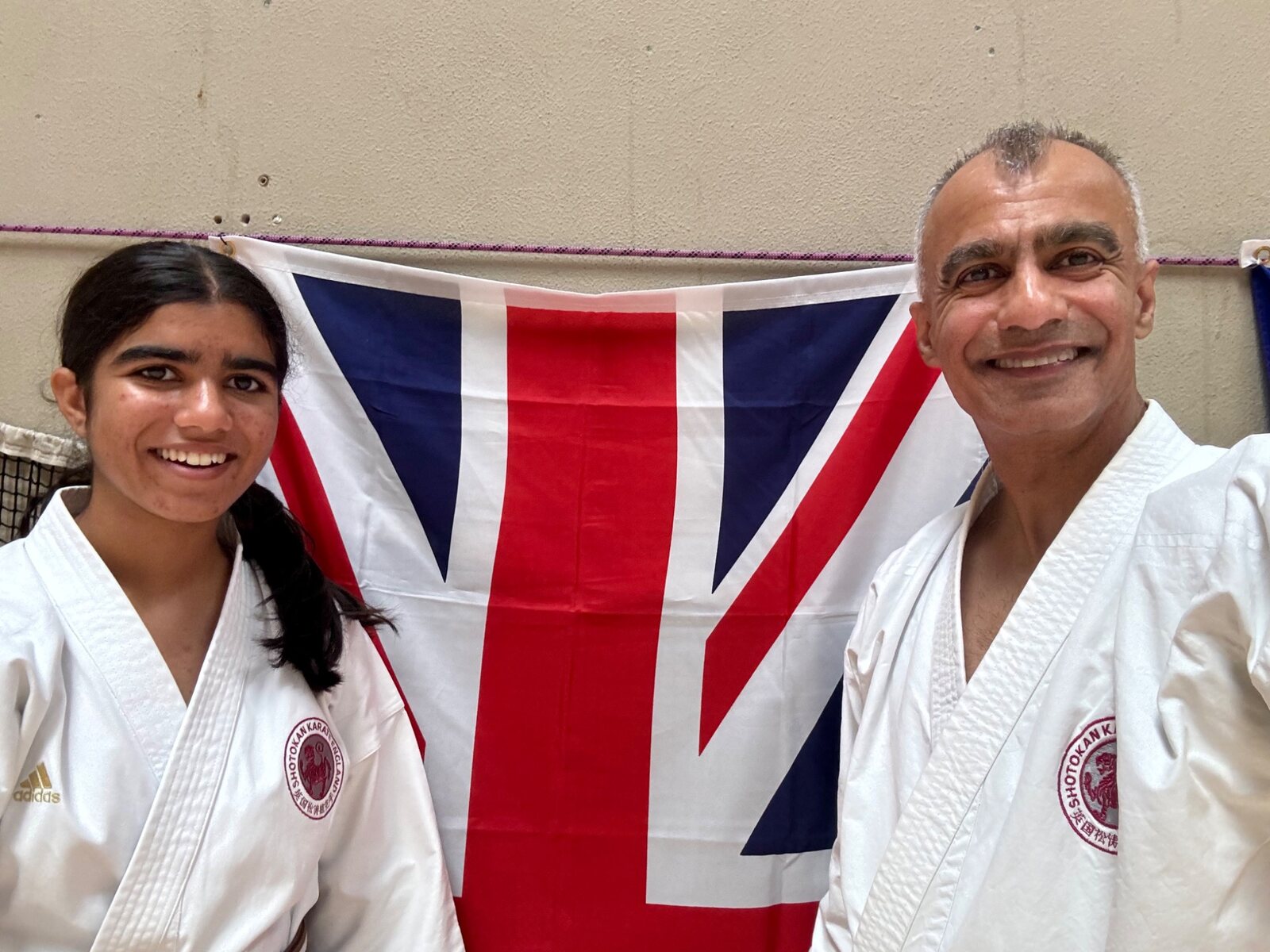
A three-week gasshuku with my daughter Amara, a Shodan: training at JKA HQ and Taishi, then with Okinawan masters in Shōrin-ryū, Matsubayashi-ryū and kobudō.
The course series connected Okinawan origins, the refinement of Japanese karate and practical Shotokan interpretation. The Wanstead edition used Wankan to explore transition, circular action, grappling, trips and falls.
The Goa programme treated physical technique as the last layer of self-defence. Participants practised awareness, verbal boundaries, de-escalation, protective movement, simple releases and movement towards help.
A personal inquiry comparing Indian Panchabhūta, Japanese Godai and elemental ideas in Chinese martial traditions. The parallels can inspire five different qualities of kata practice, but do not by themselves prove a direct historical line into karate.
Performance matters, but kata becomes deeper when rhythm, mechanics and application are studied together.
Posture, rhythm and technical accuracy provide the common language.
Ask about distance, target, control, leverage and the problem being solved.
Use progressive resistance and safe intent. Keep what remains structurally honest.
A structured reference to history, character and bunkai themes. Each entry separates broadly supported lineage from interpretation and remains open to refinement as further sources are added.
Historical baseline informed by Japan Karate Association materials and comparative Okinawan study. Personal notes and uploaded sources will be incorporated with attribution and areas of disagreement retained.
A practical Shotokan reference written for training: concise meanings, grouped by how the words are actually encountered in class.
Romanisation and usage vary between organisations and Okinawan/Japanese lineages. These entries reflect practical dojo usage rather than a claim that every school uses identical wording.
Kihon is the laboratory: isolate a quality, repeat with attention, then return it to movement.
Foot pressure, knee alignment, pelvis and spine transmit force without unnecessary tension.
Centre, stance and striking surface arrive as one coordinated event.
Excess tension slows technique and hides feedback.
A technique is incomplete if posture, guard or awareness collapses after contact.
Decisive when the opening appears, controlled enough to protect the training partner.
Understand the distance at which either person can act—and how quickly it changes.
Study go no sen, sen no sen and how to shape the exchange before it forms.
Remain mentally and physically present after the technique.
Physical response sits inside awareness, communication, judgement and care.
Read environment, behaviour, exits and changes in distance.
Use posture, position and a clear voice: “Stop. Stay back.”
Do not trade ego for safety. Keep a route out.
Cover vulnerable targets, disrupt balance and make space.
Move towards safety, seek help and record what happened.
Training should be progressive, trauma-aware and appropriate to the group. No technique guarantees safety.
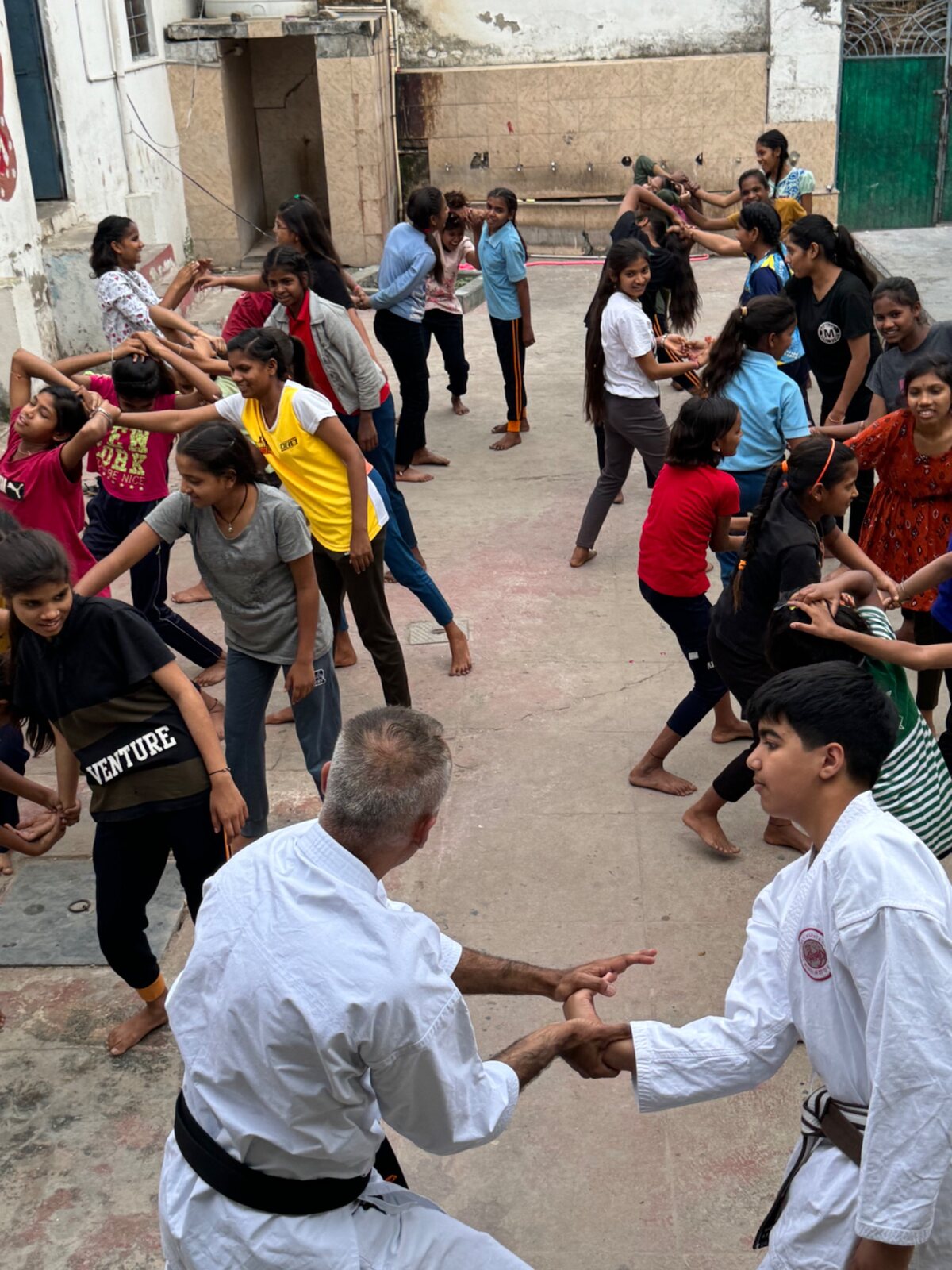
Two women’s self-defence sessions at Bethesda Life Centre, Goa, on 23–24 August 2026. The central message was explicit: the objective is to get to safety, not to win a fight.
Participants practised distracted walking, spotting exits, suspicious approaches and being followed. The colour model provided a simple mental scale:
Yellow is not fear. It is calm attention—limiting phone and headphone distraction, trusting instincts and noticing when a person, route or atmosphere changes.
Role play covered persistent strangers, unwanted attention, invasion of personal space, pressure to go somewhere, anger and blocked routes.
De-escalation is situational. It may help with frustration or volatile behaviour; it is not a guarantee against predatory intent or immediate violence.
Protective posture, voice, movement, palm strikes and close elbows were trained on pads before partner scenarios.
The recurring pattern was: stabilise, protect, break contact, create space and leave.
Fight, flight and freeze change decision-making. Scenarios were kept simple enough to recall under stress and resistance was added only where appropriate.
Helping people recognise their choices, use their voice and believe in their capacity to act.
Awareness, boundaries, de-escalation and practical escape skills.
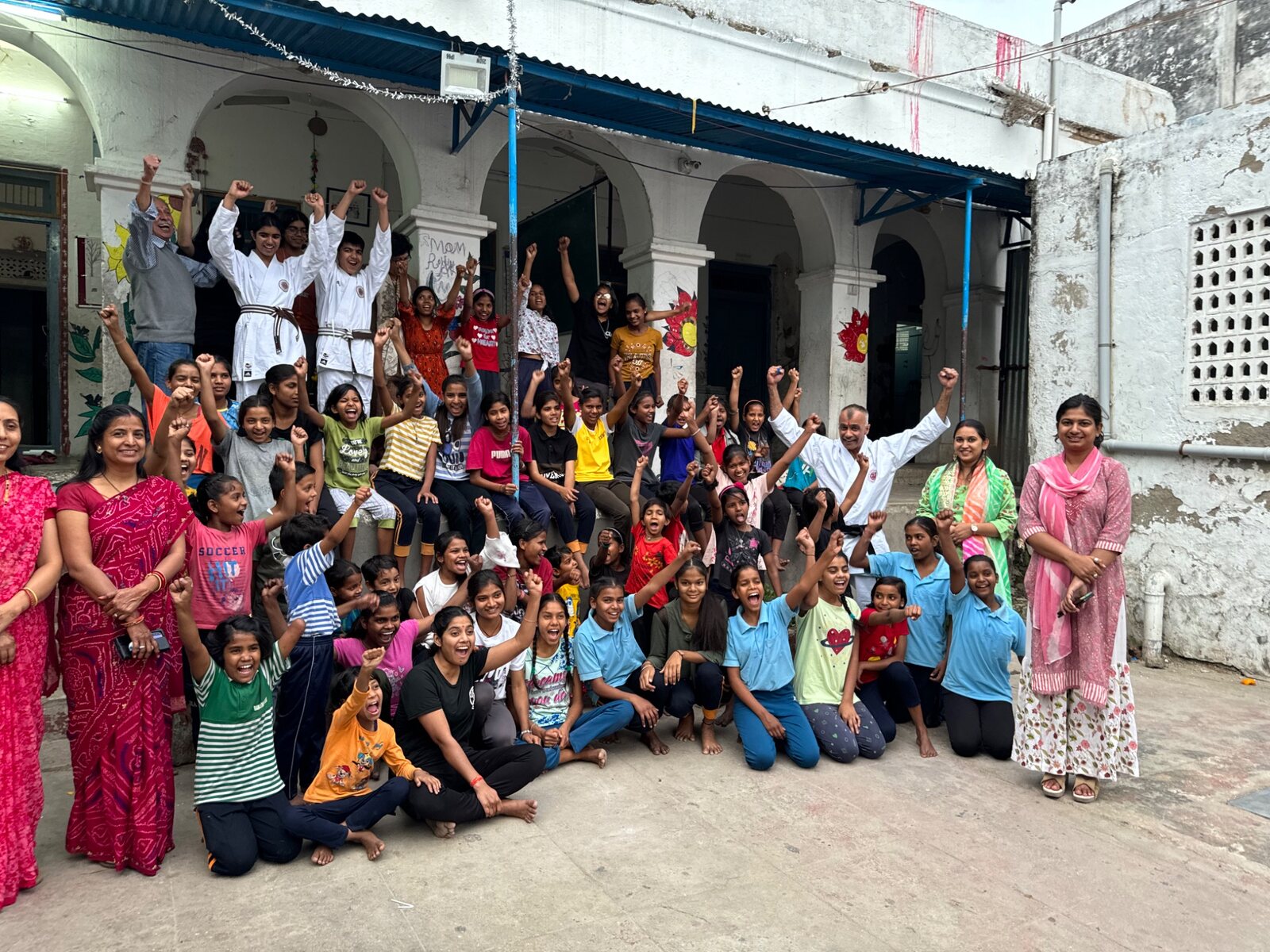
Project Pearl workshops in Goa, supported by my family and SKE.
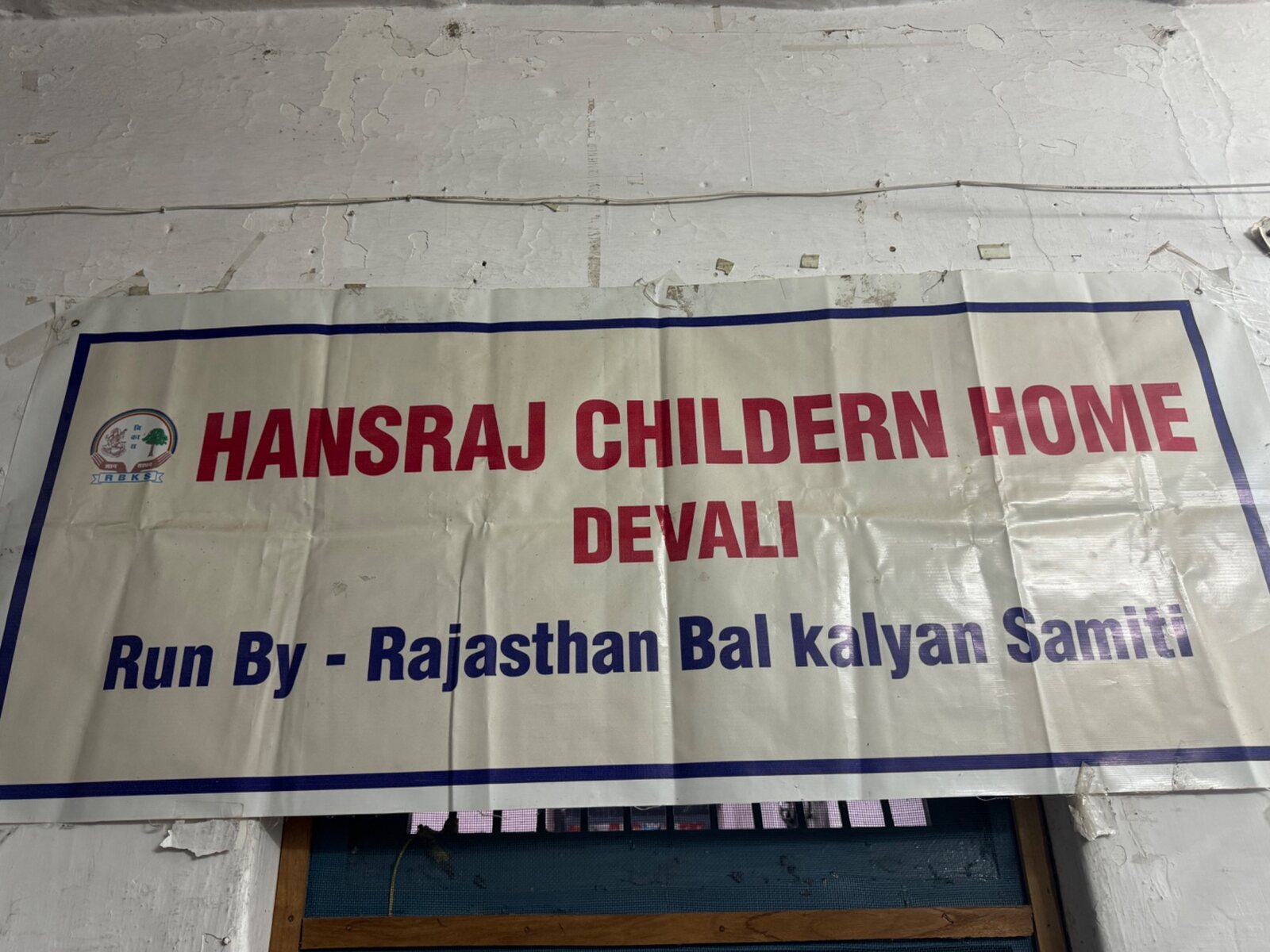
Self-defence for Hansraj Children’s Home, centred on confidence and safety.
Using martial arts knowledge in service of young people.
Personal teaching and seminar notes preserved as practical study: what the movement teaches, how it changes with contact, and which larger principles survive beyond a single sequence.
Sensei Gavin Kendal and I built the course around Roshu, the Asai kata I was taught by Bertel Sensei. The kata’s quality is not rigid force. It gathers, redirects and releases power through relaxed, continuous movement.
Move “like an ocean wave”: yielding without becoming weak, returning with natural velocity.
The supplied Bertel Sensei notes record Roshu as a 60-count kata, with several movements containing two counts, and retain alternate technical versions where taught.
Notes from training with Sensei Iain Abernethy and Sensei Les Bubka focused on Okuden-level understanding: not a catalogue of secret techniques, but deeper combative principles that connect many kata.
Meikyō, Enpi, Gojūshiho Shō, Unsu, Bassai Dai, Kanku Dai and Jion were used to explore rotation and slamming, trips and ground control, throws, angle changes, limb control and the functional meaning of hikite as seizing and pulling.
Partner work finished with grappling and controlled takedowns, with each person drawing solutions from their own kata rather than copying one fixed answer.
The Barnet course presented karate as a complete journey rather than a single modern style.
A 100-minute course for 5th kyu and above at East Barnet Dojo.
The Wanstead course turned the journey into a demanding 75-minute training progression.
The course closed by asking younger students what they had learned, reinforcing reflection as part of training.
Your notes compare Musashi’s elemental language with the Indian Panchabhūta—earth, water, fire, air and space/ether—and with Japanese Godai. Shiva’s five faces and the five-syllable Panchakshari mantra show how deeply the number five operates in Hindu cosmology.
Historical caution: the resemblance between Panchabhūta and Godai is a valuable comparative lens, but similarity does not establish that Vedic scripture directly shaped karate, or that the five Heian/Pinan kata were designed as elemental forms. The Pinan series is more securely understood as Itosu’s pedagogical system. Chinese Wu Xing also uses a different set—wood, fire, earth, metal and water—and should not be collapsed into the same scheme.
Perform the same kata five times, changing the governing quality rather than the sequence: rooted for Earth, seamless for Water, decisive for Fire, mobile for Air, then receptive and economical for Void. This turns the elements into a method for investigating balance, rhythm, tension, intent and adaptability—without claiming a lineage that the evidence cannot yet support.
When karate entered the Olympic programme, the Team GB moment created a rare public spotlight. Copthall Karate Club answered it with a 15 August exhibition designed to make Shotokan understandable, progressive and welcoming.
The plan did more than display advanced skill. It showed how a student develops from first techniques to free practice, then invited children and parents onto the floor to experience karate themselves.
Teaching idea: give the audience a visible pathway—fundamentals first, increasing complexity next, practical expression last—without losing control, etiquette or safety.
Jōdan-zuki, age-uke, ude-uke and mae-geri; Kihon Kata; then controlled three-step sparring demonstrated at proper distance.
Combination kihon and mawashi-geri, followed by Heian Yondan and one-step sparring finishing with ushiro-geri.
Longer combinations, ren-geri, Bassai Dai and Enpi, then jiyū-ippon, pad work, light freestyle and practical Enpi bunkai.
Punches, stances, age-uke and mae-geri were taught with club students dispersed among newcomers as guides, ending with the dojo code and an invitation to train.
A three-week gasshuku through Tokyo and Okinawa with my daughter Amara, a Shodan—modern JKA precision followed by older Shōrin traditions, kobudō and the places where karate’s history still lives.
At JKA HQ with Naomi Yamamoto Sensei, apparently simple routines became demanding through 15–20 repetitions on each side, paced slow, medium and fast. Kanku Dai was rooted by a partner pulling down on the belt during the transition into renōji-dachi; gohon kumite sharpened distance through repeated kick counters.
At JKA Taishi, Naka Sensei built speed from relaxation: power like a whip from the hara, shoulders following rather than leading, compression and expansion, and rapid changes to 45° lines. Kihon, kumite and kata—Jion, Meikyō, Sochin and Tekki Shodan—were all stripped back to intense repetition.
Morinobu Maeshiro Sensei’s Shōrin-ryū sessions used short upright stances, multi-directional kihon and Pinan kata without kiai. We compared the reversed Pinan/Heian ordering, different Pinan Sandan movements, and two very different Passai forms.
Makiwara training was woven into every break: zuki, haitō, shuto, soto-uchi and low mawashi-geri. The lesson was not spectacle but lifelong conditioning, repetition and exchange between students.
With James Pankiewicz Sensei, Shōrin-ryū revealed higher hikite, upright posture, square receiving actions and the inward-turned shuto thumb—both structural and immediately usable as an attack. Kobudō with Tony Roberts Sensei and Pankiewicz Sensei connected familiar karate shapes to bō, sai, nunchaku and tonfa.
Weapon handling made distance and timing tangible: protect before changing grip, extend range when necessary, and let the tactical problem decide the movement. Hatha yoga with Yuri Sensei added the other half of longevity—breath, flexibility, spinal release and repair.
At 82, Toshimitsu Arakaki Sensei’s conditioning and strength were extraordinary. His tiny dojo demanded short stances and constant changes of direction. Pinan and Taikyoku Shodan bunkai were practised in threes, with a clear rule: the kata should still be recognisable inside the application.
Bunkai became paired kumite; bō work protected the knee, used cue-like thrusts and trained four-direction block–strike patterns. Training ended by cleaning the floor together—a small act that expressed the culture of the dojo as clearly as any technique.
The tour with James Pankiewicz Sensei joined training to place: the Karate Kaikan and museum, the old red dojo, Funakoshi memorial and school site, Nagamine memorial, family tombs once used as secluded training spaces, and the cave associated with Chintō.
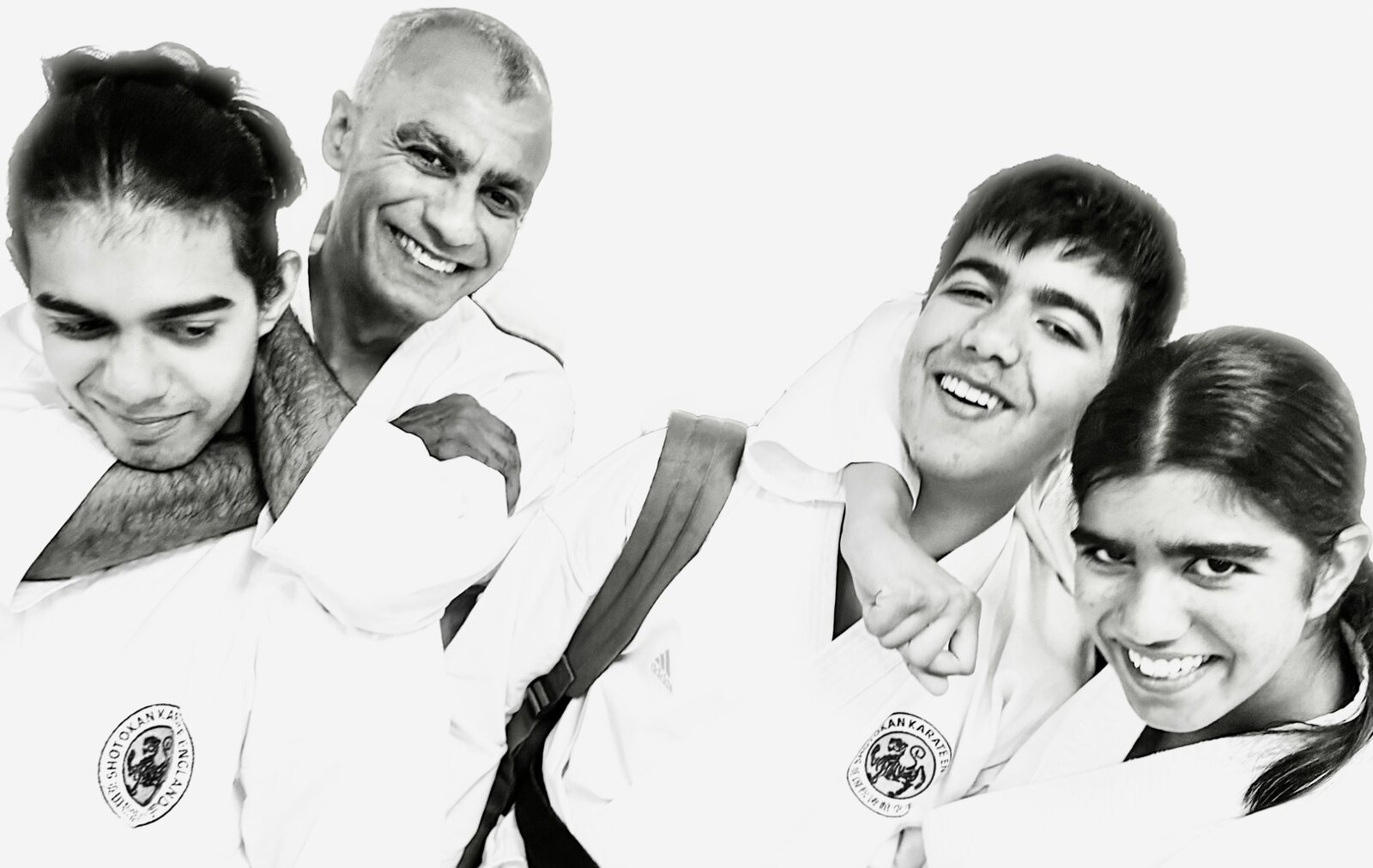
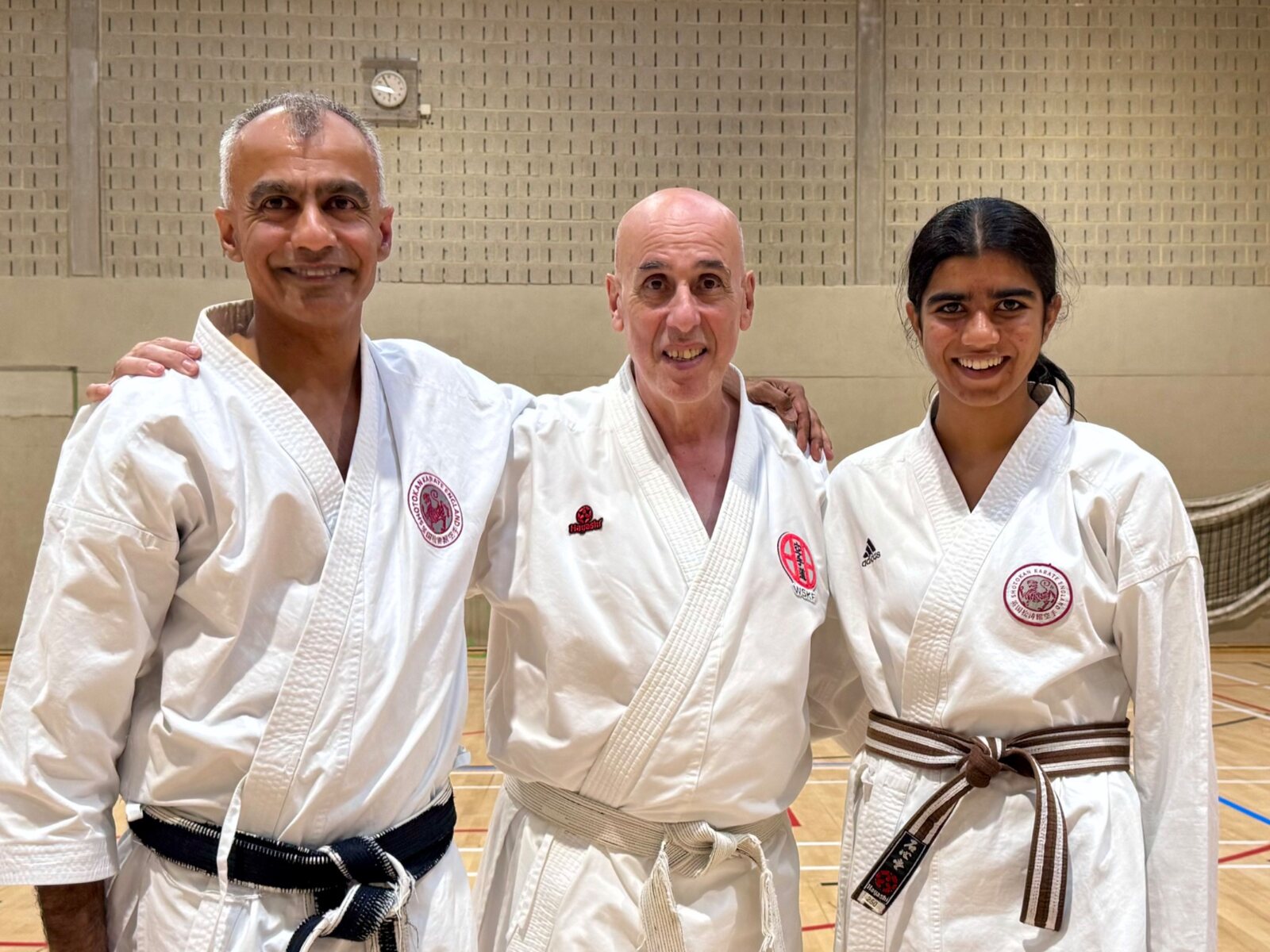
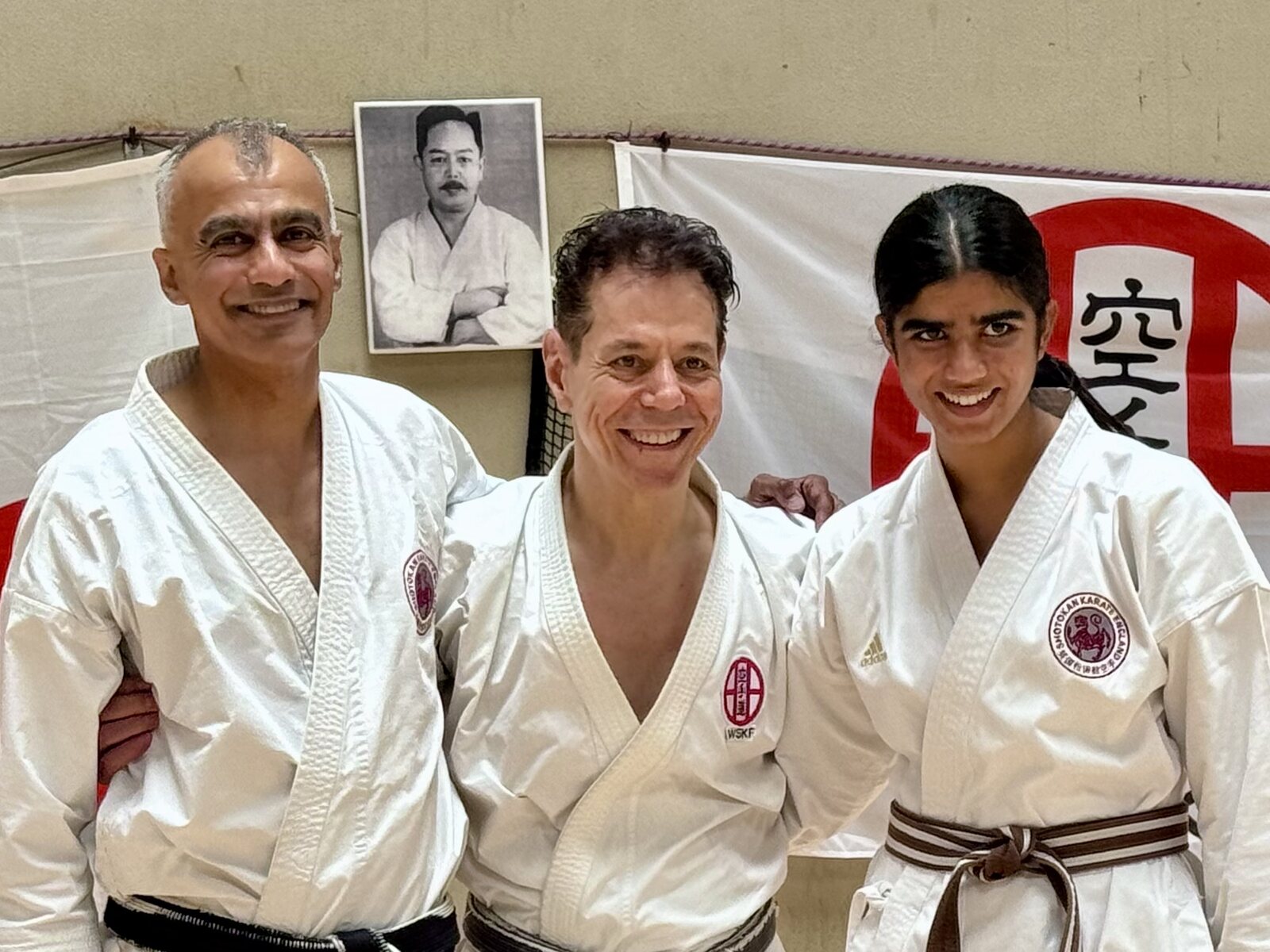
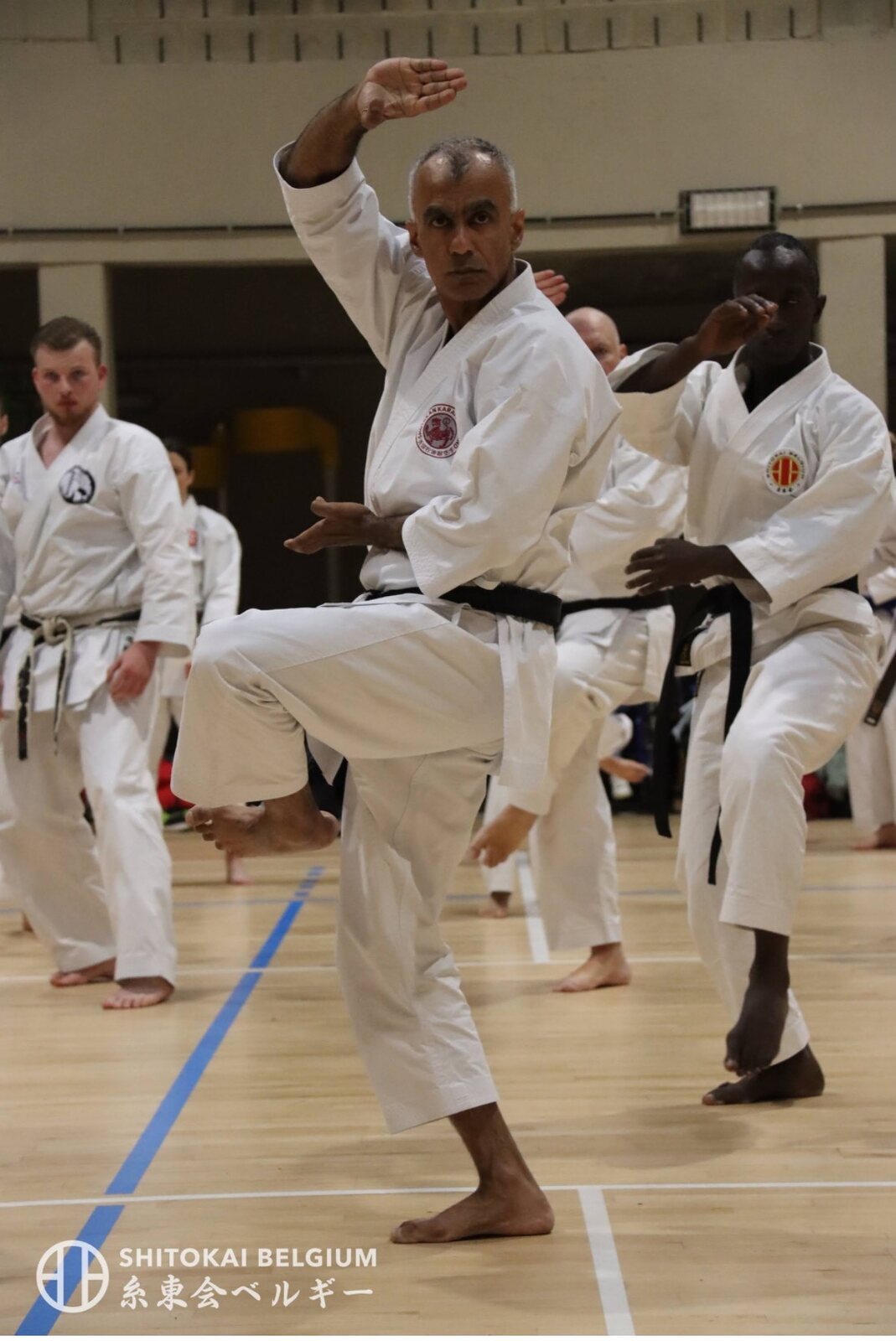
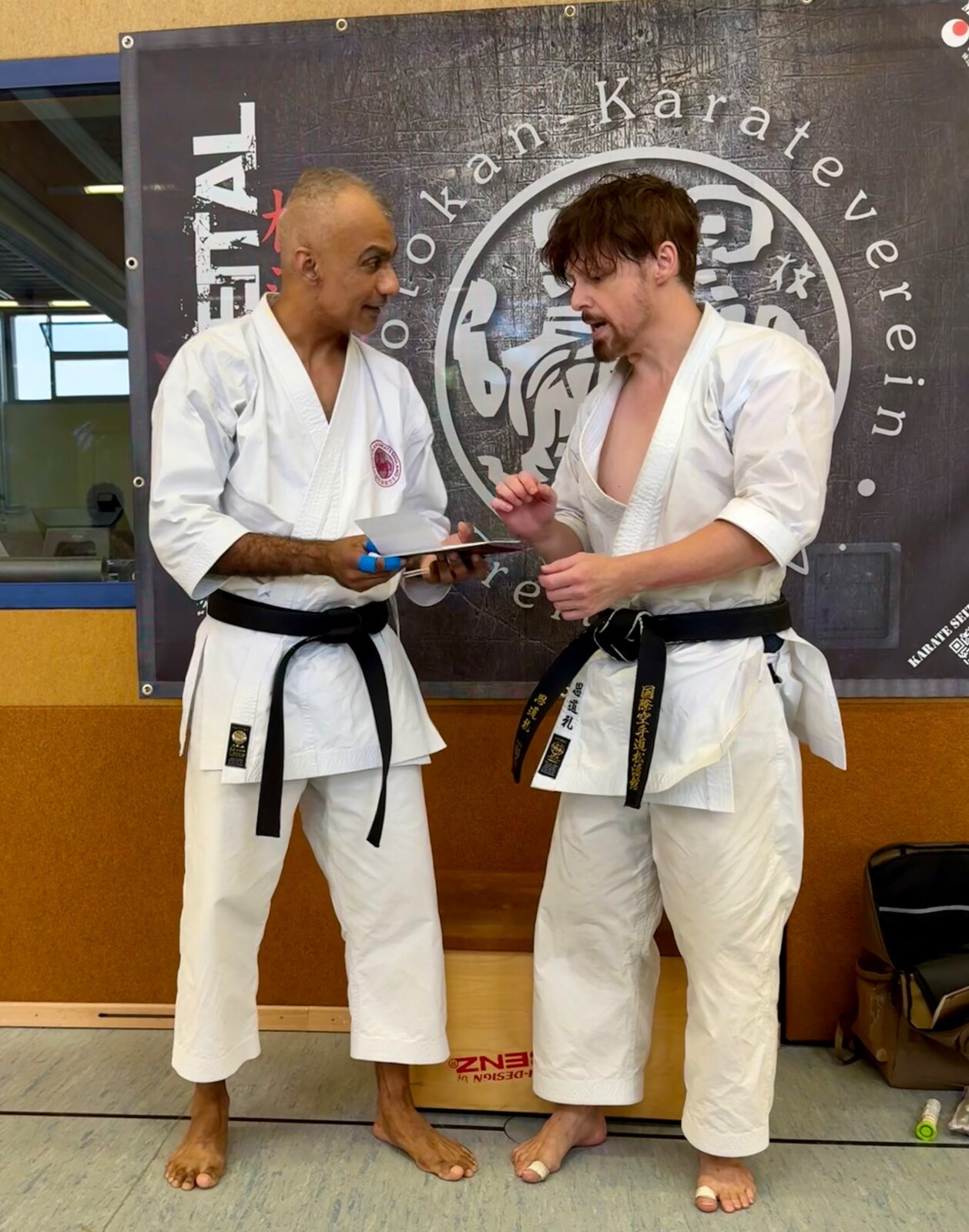
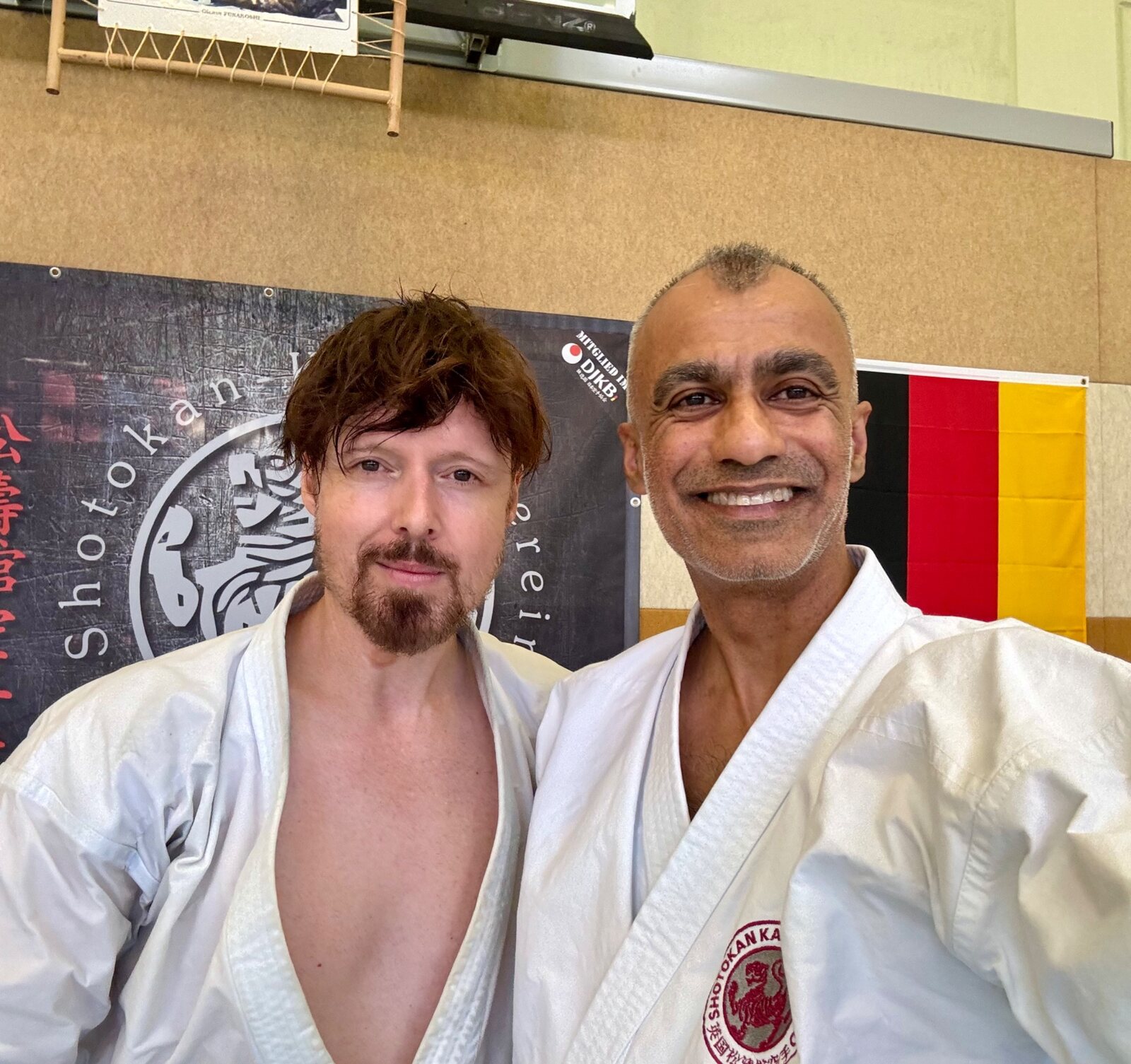
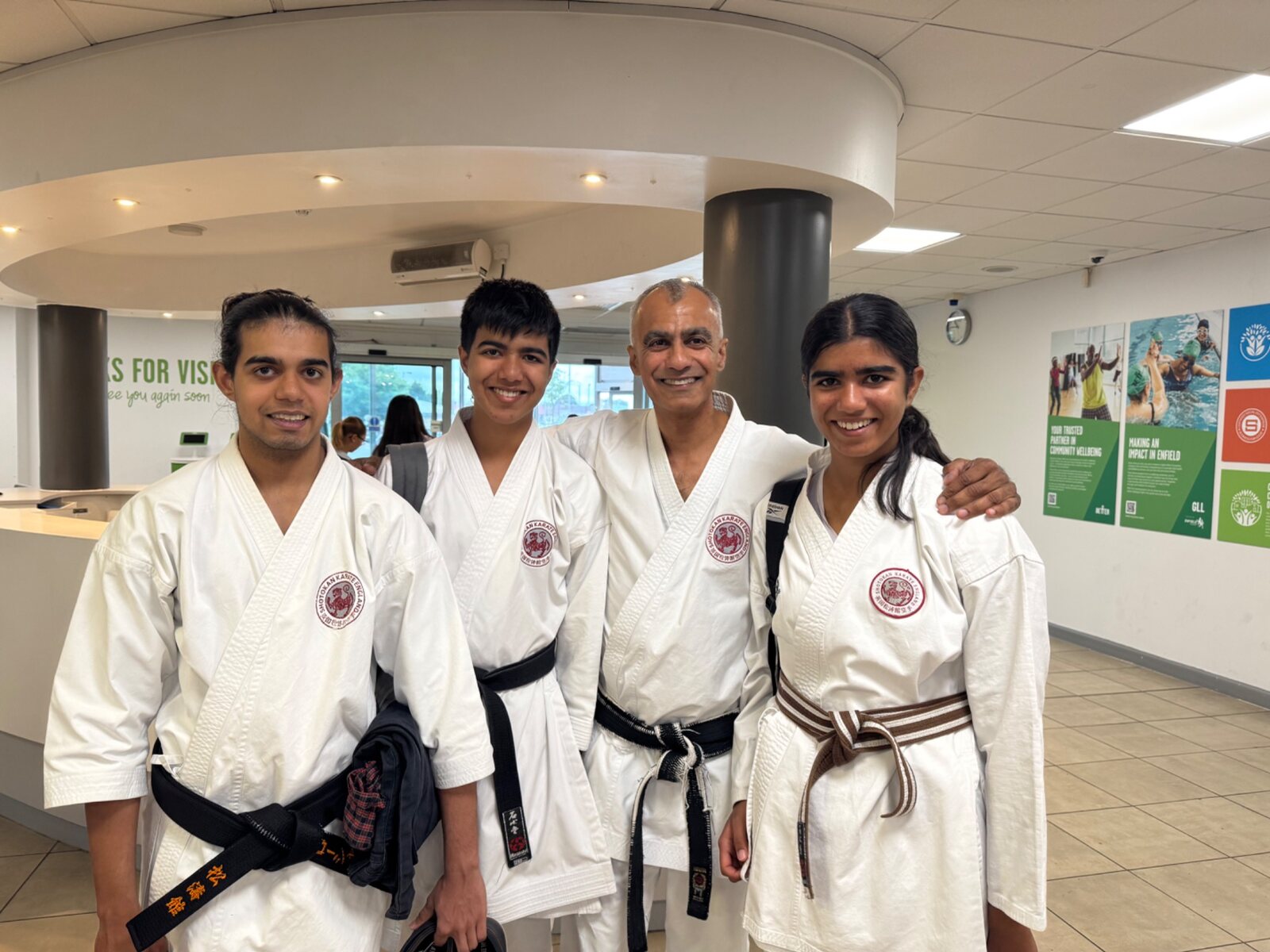
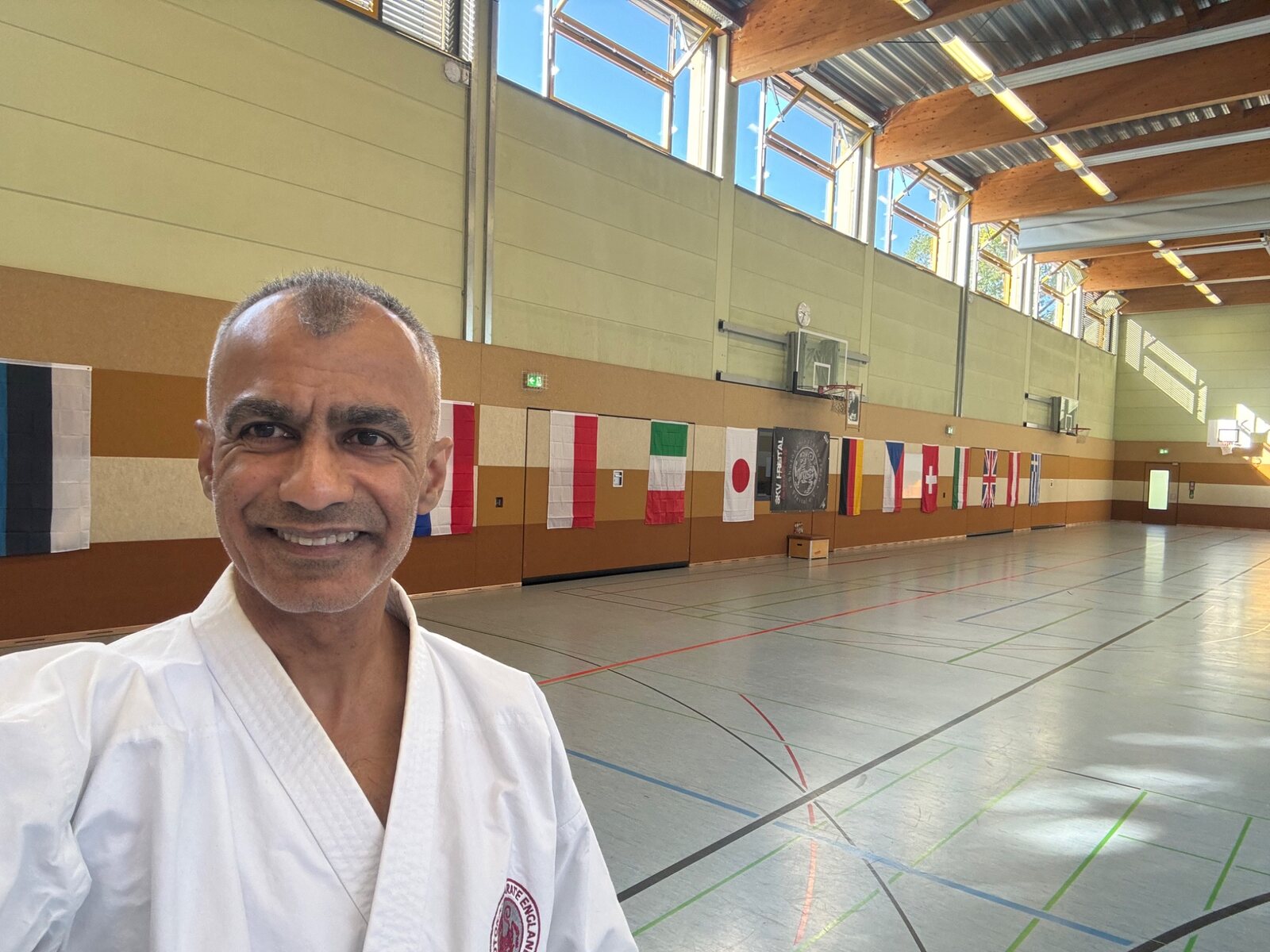
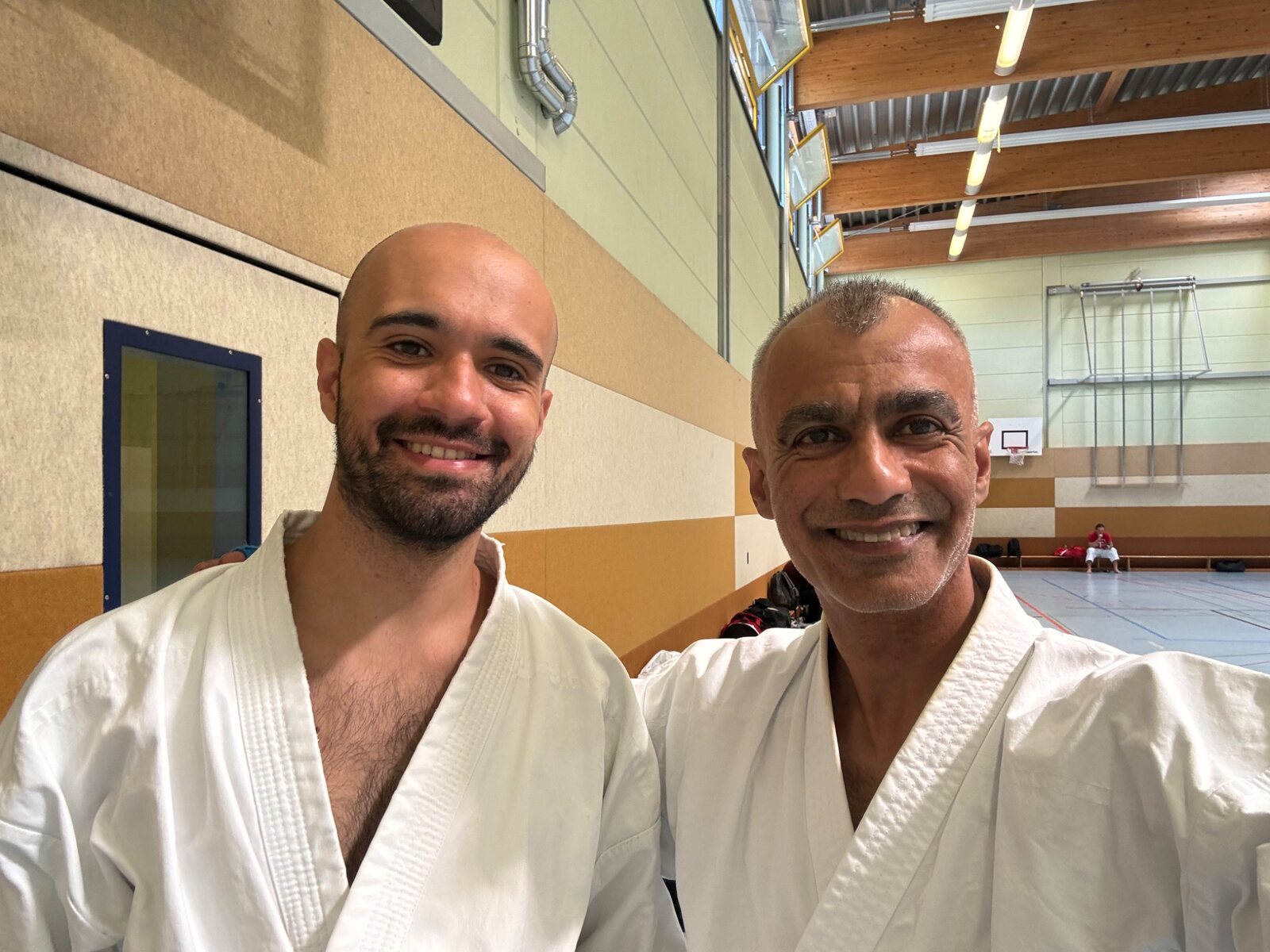
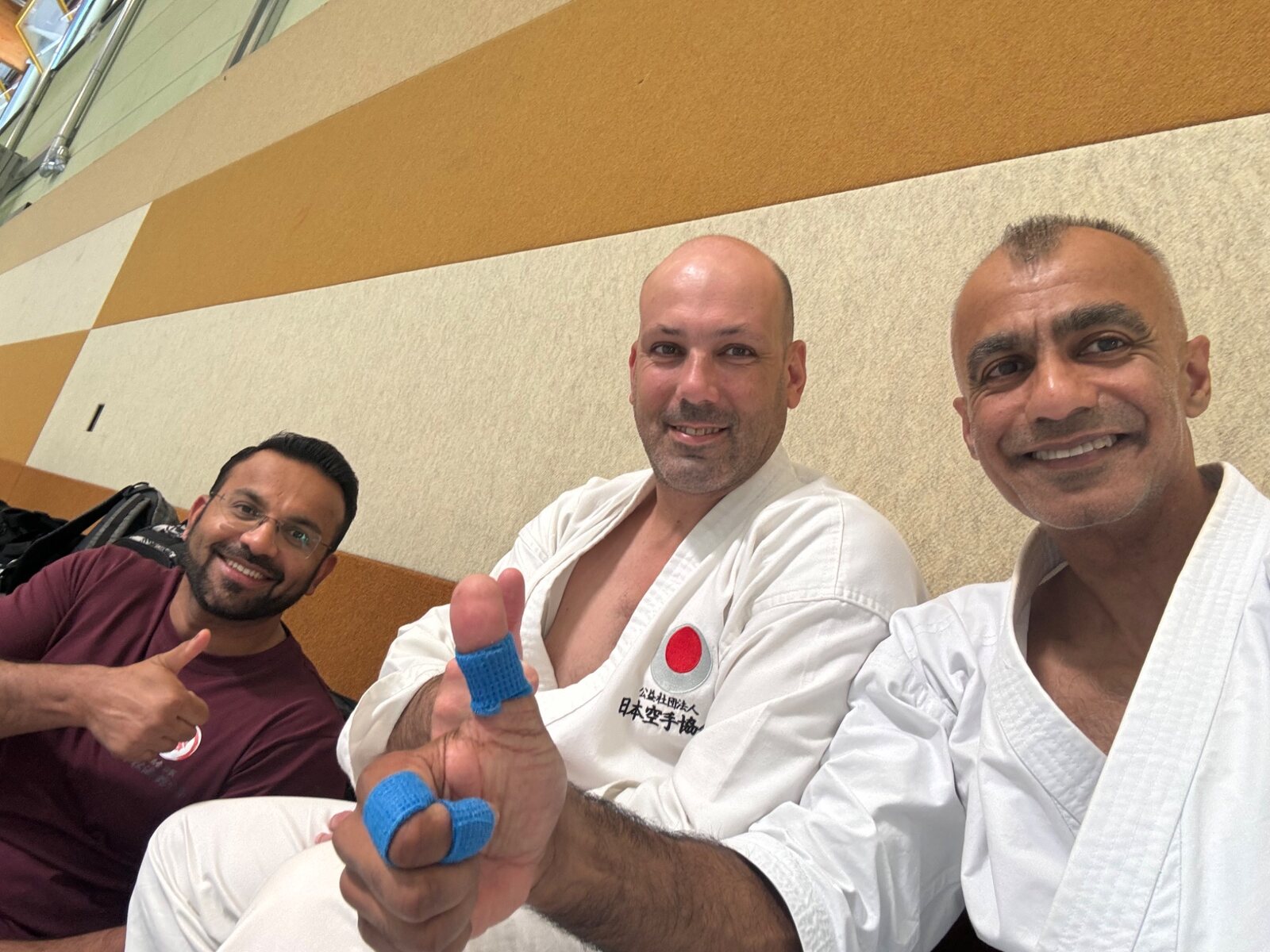
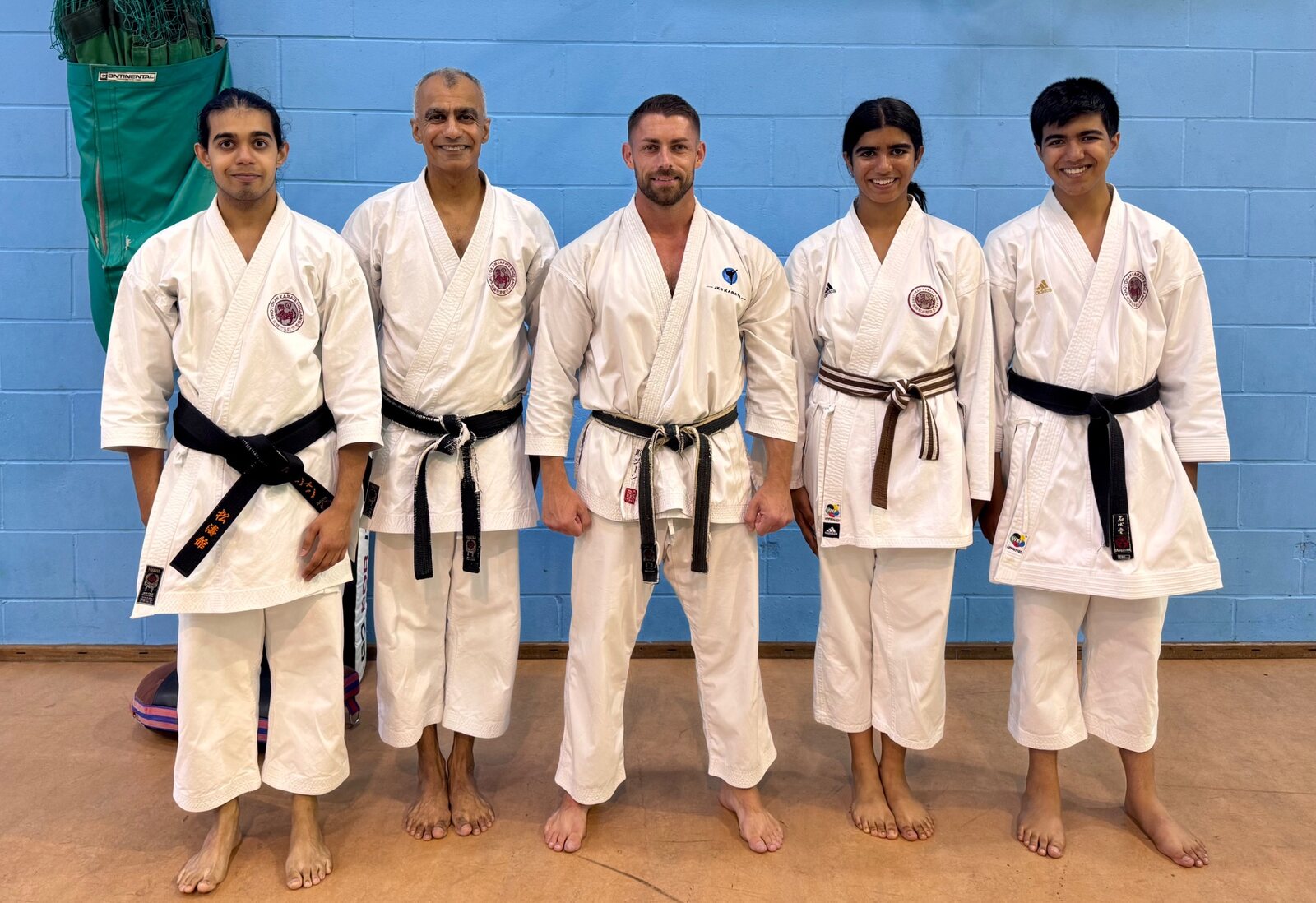
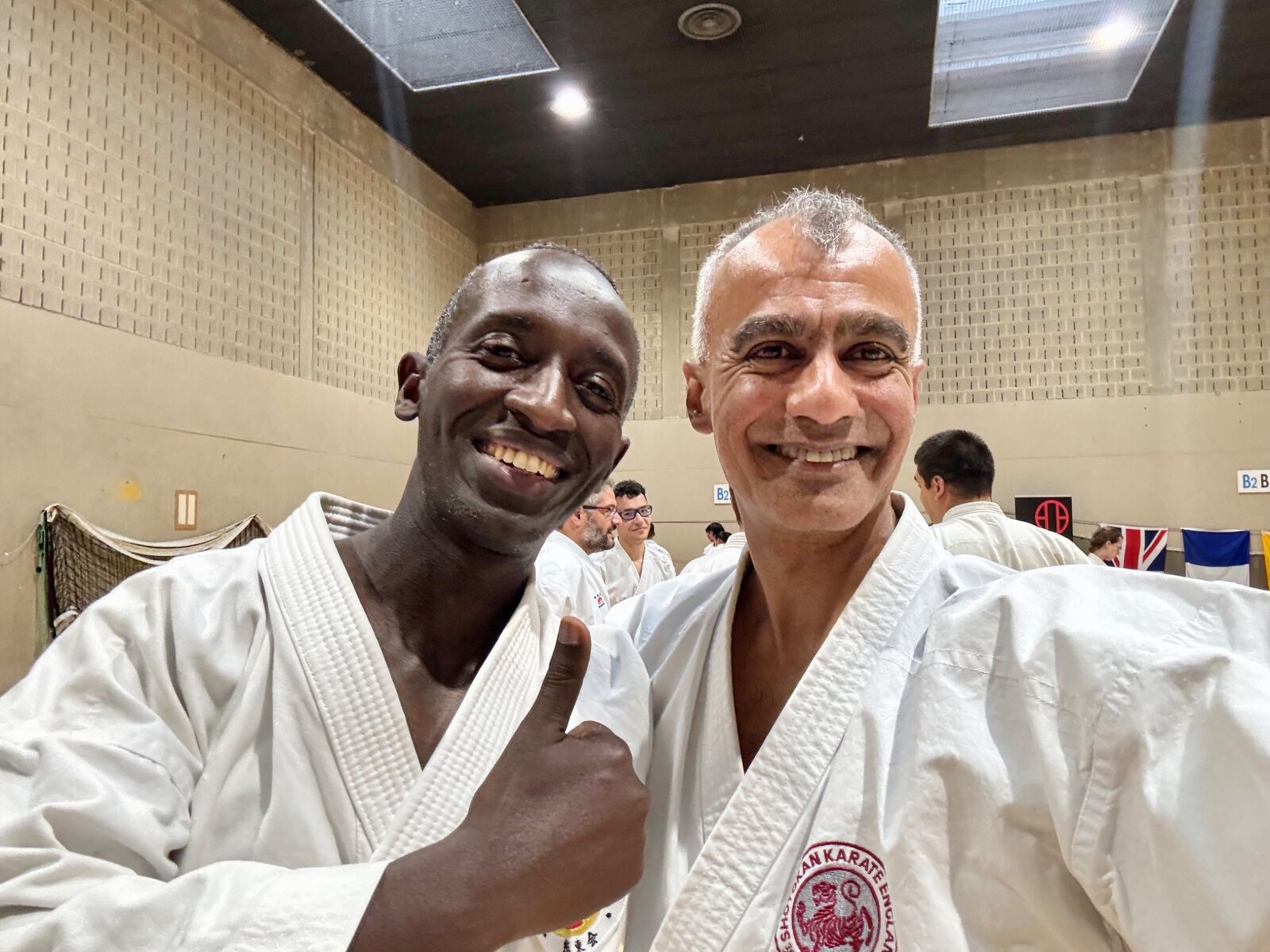
The complete photographic collection supplied for this site: Okinawa, international seminars, kata, family training, fellow karateka and charitable self-defence work.
“If you have a talent, use it to shine a light for others.”